An introduction to … Duncan

Caroline refers to Duncan, her ex-husband, as “That Man” for much of the novel. Their divorce was not amicable, though they just about tolerate each others’ presence for the sake of their teenage daughter Emily (who successfully plays Caroline and Duncan off against each other whenever she wants something!)

“Duncan? He’s an ugly little man with glasses that are far too large for his face. Oily grey hair and a stupid beard. You can’t miss him,” said Caroline.

duncan manor

image from Pixabay.

Duncan, a professor at the University of Saddleton, is an expert on the life and works of Gilbert Fox-Travers, the architect of Misterley Manor. It’s how he and Caroline met, when he came to the Manor in his early twenties to do some research. Caroline’s father often accuses him of only being interested in the house and using Caroline as a way to get it.

He has also annoyed Alice:

Duncan Russell was the professor she had asked to supervise her PhD. He was the leading British expert on Fox-Travers, based at Ormsborough University, thirty miles away from Misterley over the moors. But he hadn’t thought her PhD proposal was worth more than a standard rejection letter. Because of his swift and thoughtless rejection, she privately suspected that Duncan Russell might be a bit of a shit. She wouldn’t dream of saying that to Caroline though.

 ‘Yes, I’ve come across Professor Russell,’ she said, as politely as she could.

‘Between you and I, he’s a bit of a shit,’ said Caroline.

Duncan is irritating, interfering and always thinks he knows best. However, increasingly, it begins to appear that perhaps, just perhaps, Duncan might have known what he was talking about after all … so can Caroline admit that he was right and accept his help? And why, after all this time, is he still trying to interfere at Misterley?

An introduction to … Tom

I knew from the moment I started writing that Tom would have to be the “strong, silent type”. He’s the assistant gardener at Misterley Manor, a man who loves his work, he’s happy to be working where he is, in the open air, and doesn’t want to be anything other than what he is.

tom manor image

Image from Pixabay.

Do you know what the hardest thing is about the “strong, silent type” of hero? They quite often just hang around in the background thinking noble thoughts and doing noble deeds but not saying very much … which makes them very difficult to write into a conversation!

Deeds mean more than words to Tom, so when he is unable to prove himself in a crucial situation (so difficult to explain without giving away too much of the plot!) it’s hard for him.

He’s attracted to Alice, but for several reasons (again, I can’t tell you too much or the plot will be spoiled) he holds back.

So, when the chips are down at Misterley Manor, Tom can be found rolling up his sleeves and getting stuck in – his hands are always dirty with working in the garden anyway – but he won’t talk about it very much …

An introduction to … Caroline.

Caroline Lattimore in “The Manor on the Moors” wasn’t meant to be a heroine at all; she was meant to be an antagonist! Where Alice was meant to be sweet-natured, obliging and kind Caroline was to be her complete opposite. And in fact she still is. If there is a situation to be handled with kid gloves, Alice will stroke the problem gently and ask it nicely to go away, but Caroline will barge in there with her steel toe-capped boots on and kick it. Caroline will not allow anyone to help her and spends most of her scenes with an ironic eyebrow or two raised in comment – but I loved writing about her. She sprang off the page, kicking and screaming where Alice sometimes had to be coaxed to do anything at all.

caroline manor image

It was incredibly difficult to find a picture to sum Caroline up. For a start, she’s in her fifties, and women in their fifties are not easy to find on Pixabay – but that’s a whole different post to write one day. She has distinctive short white hair – when most of the women of Pixabay have flowing blonde or brunette tresses. The best I could do was an image that seemed to sum up Caroline’s attitude to life – a slightly awkward-looking woman in a sensible coat.

Caroline is the daughter of the owner of Misterley Manor and she’s in charge of the grand stately home. But she finds her job increasingly a struggle: she’s spent “… the last few, lonely years … locked away here at Misterley Manor fighting the rising tide of debt, decay and disorder.” For a start her family are no help. A stubborn elderly father, an eccentric aunt, a daughter who spends most of the novel chasing one of the builders, and then there’s her ex-husband Duncan. “That Man”, as she refers to him, just won’t keep his nose out of her affairs. But Caroline just puts her head down and gets on with life, upholding the Lattimore family motto “Pride and Strength”.

The big question is, how long can Caroline’s “Pride and Strength” keep her going?

An introduction to … Alice

Over the next week I’d like to introduce you to some of the main characters in “The Manor on the Moors” and what you might expect from them … and we start with Alice Goudge.

Alice? Alice? Who the heck is Alice? I hear you ask. Well, that’s not quite what I hear you ask, but I’m not writing that on my blog!

Alice is the most straightforward of romantic heroines, the girl who begins the novel suspecting that she is with the wrong man.

alice manor image

Photo from Pixabay.

Alice is a young PhD student who has arrived at Misterley Manor to study the mysterious disappearance of architect Gilbert Fox-Travers a hundred years ago. Her goal is straightforward – she wants to be the one to solve the mystery, with all the academic glory that it might bring her. However, Sebastian, her boyfriend, has other ideas. He doesn’t like her going off to work in Yorkshire and leaving her home in London. Sebastian needs Alice. But Alice is no longer sure whether Sebastian is quite what she needs; he’s changed since they met as undergraduates several years ago. And then she meets Tom, the handsome but slightly reticent assistant gardener, and everything gets very complicated for poor old Alice …

Alice isn’t beautiful and she knows it. “All through her life people had told her that she “looked just like an Alice!” with her thick blonde hair and blue eyes, but the hair and eyes were all that fitted with the picture-book-pretty idea of an Alice. Her face was too square, and her jaw was too strong for an Alice, her shoulders were too broad, and her teeth were too prominent.” But Alice is clever and Alice is kind. She might lack confidence at times, and she is still coming to terms with who she is and what she wants from life.

So Alice has several problems to solve during the novel: Where does she belong? Who belongs there with her? Can she trust herself to choose the right thing? And what the heck really did happen to Gilbert Fox-Travers?

I’ll give you a clue – of everybody in the novel, you can probably trust Alice to do the right thing when the chips are down.

The inspiration behind Misterley Manor- Grey Towers.

Misterley Manor, the setting for “The Manor on the Moors” was partly inspired by Grey Towers, a mansion to the south of Middlesbrough. My imaginary house is larger and built fifty years later, and it sits on the edge of the moors, rather than the edge a town, but it shares a heritage with Grey Towers, both historically and in the landscape of my imagination.
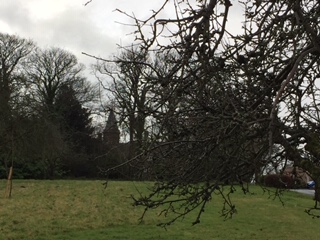
image1 (17)

Grey Towers seen through the branches of the old orchard.

In the late nineteenth and early twentieth century Middlesbrough was an expanding town with a bright future. “The Infant Hercules” of iron and steel production run by ironmasters with solid, resonant names. Bolckow and Vaughan. The Bells. Dorman and Long. Swann. And these ironmasters had the wealth to build themselves impressive new homes around Middlesbrough, just as Sir Edward Lattimore does in  “The Manor on the Moors”.


image1 (18)

Grey Towers, front

One of these ironmasters’ houses was Grey Towers in Nunthorpe, built originally in 1865 by William Hopkins who owned the “Teesside Ironworks” company. Sadly this company was responsible for the iron which built the Tay Bridge and following its disastrous collapse Hopkins went bankrupt. Grey Towers was eventually sold to Sir Arthur Dorman. His company, Dorman-Long, built the iconic Sydney Harbour and Tyne Bridges – neither of which have collapsed so far – and Dorman lavished further attention and money on Grey Towers. It was an almost theatrical house, framed by its spectacular gardens and with a backdrop of the picturesque Cleveland Hills.
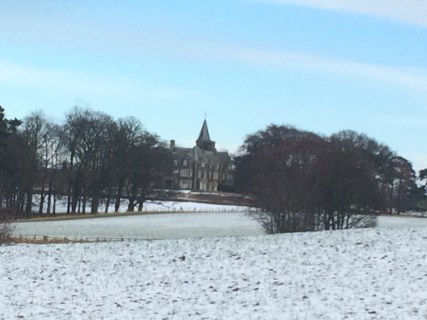
image1 (19)

Grey Towers in winter.

Sir Arthur Dorman died in 1931 and the house was sold to Alderman Poole, who donated it to the people of Middlesbrough to be used as a hospital, and latterly as accommodation for the hospital staff. Poole Hospital finally closed in 1988 and the house had been unused for a while before that.

Grey Towers has been part of my imaginative landscape for as long as I can remember having an imaginative landscape! It fascinated me as a child and I first remember it as part of the  hospital. The closest I ever got to going inside the house was standing outside to sing carols for the hospital patients in the winter. Glimpses through the windows seemed to show nasty 1960s wallpaper and institutional doors and furniture. Raised on a diet of historical novels (most of them involving time travel or ghosts) I was disappointed by the glimpses of the mundane interior, and preferred to imagine my own. But, it turns out that there were still original features hidden there; ceilings and fireplaces, and underneath all the later decorations even the original high Victorian peacock wallpaper, panelled over by Sir Arthur Dorman in the 1870s and now in the Dorman Museum.

image1 (20)

Grey Towers, the garden side.

As the house remained locked up and the decay of a decade began, it was just possible to peep through the boarded up windows of what I imagined had been the ballroom. Some of the lads in my class at school claimed to have gone in and explored; the floor being wooden had started to rot in places and it looked like the end of the road for Grey Towers. Ghost stories began to circulate, the old hospital buildings next to the house were like something from a horror film (see https://www.gazettelive.co.uk/news/nostalgia/haunted-poole-hospital-grey-towers-9213485) and it was around this time I first heard rumours of a “grey lady” said to haunt the house and gardens.

If anything, Grey Towers became more romantic precisely because it was abandoned and because I had never seen more than the odd covert glance inside. My imagination filled it with antique furniture draped in cobwebs, like a scene from “Great Expectations”.

image2 (2)

The garden side, looking over what in my imagination must have been the croquet lawn.

However in the 1990s the house was sold and then it was turned into apartments. Very exclusive apartments. I’ve still never been lucky enough to see inside the house. I had the opportunity – the developers opened the house for local people to look round, but I was in the early stages of pregnancy and too nauseous to get there, so I’ve still never been inside, which means that my imagination can still furnish the inside of the house however it wants to.

And my imagination furnishes it with an octagonal library, a long gallery, carved panelling, stained glass windows, secret rooms, hidden doors and locked cupboards …

To see more images of Grey Towers, see the website of artist Ingrid Sylvestre who has painted Grey Towers many times. http://ingridsylvestregreytowersart.blogspot.com